

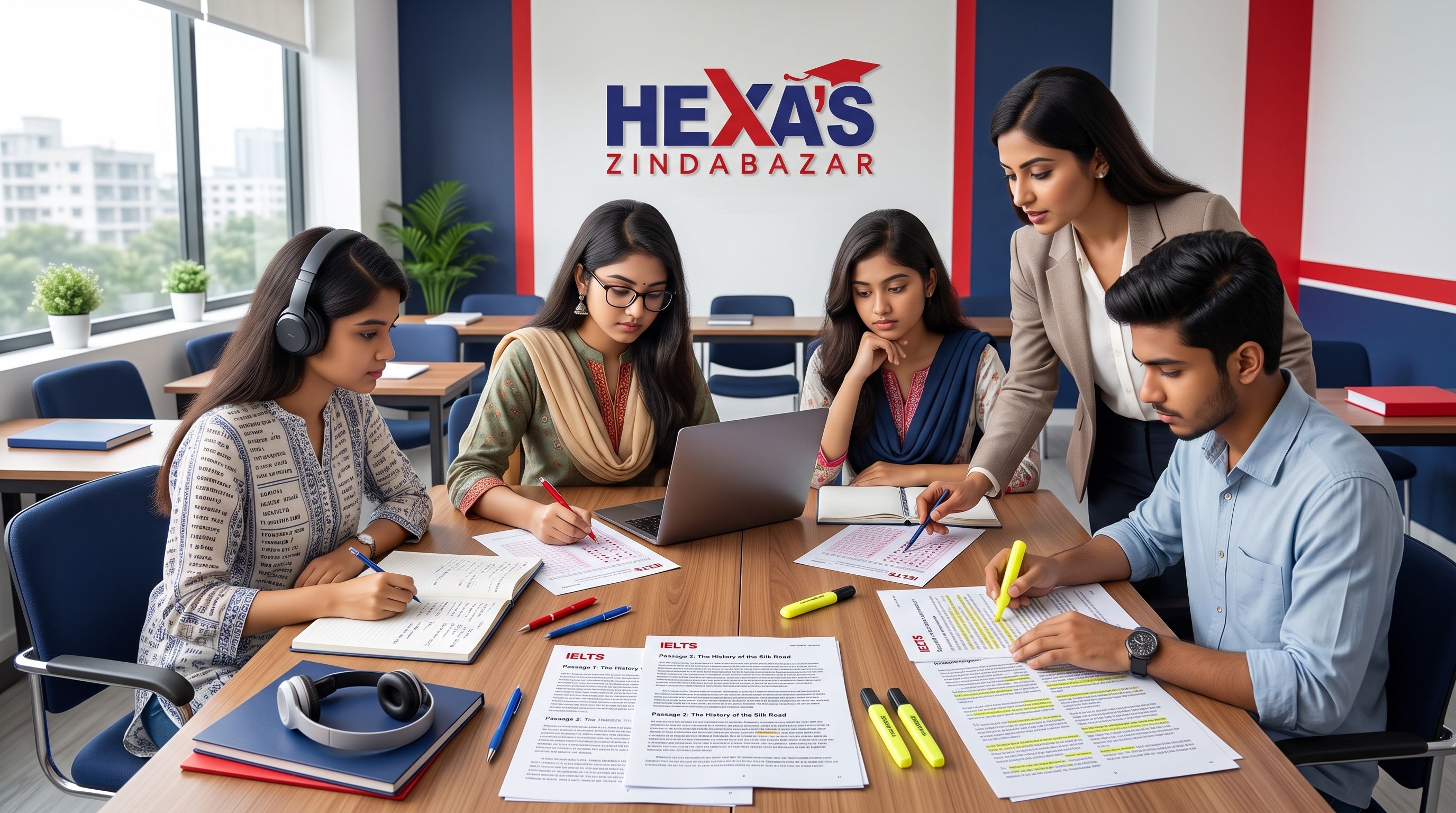
IELTS Reading can be frustrating.
You may understand most of the passage, know the vocabulary, and still get several answers wrong.
Why?
Because IELTS Reading does not simply test whether you can understand English. It also tests whether you can locate information, identify main ideas, understand arguments, recognise opinions, and follow instructions accurately under strict time pressure.
Many candidates lose marks because of avoidable mistakes rather than a complete lack of English ability.
The good news is that once you identify these mistakes, you can change the way you practice.
This guide explains the most common IELTS Reading mistakes and how to avoid them.
First, Understand the IELTS Reading Test
The IELTS Reading test lasts 60 minutes and contains 40 questions.
Both Academic and General Training Reading have three sections, although the types of texts differ.
One important detail is often overlooked:
There is no extra time for transferring answers in the Reading test.
Your 60 minutes include the time required to complete and submit your answers.
This makes time management extremely important.
Mistake 1: Reading Every Word of the Passage
One of the biggest mistakes beginners make is trying to understand every sentence before answering the questions.
IELTS Academic Reading contains thousands of words across three sections.
Reading every sentence slowly and carefully can consume too much time.
You also do not need to understand every unfamiliar word to answer the questions.
What Should You Do Instead?
Develop two important skills:
Skimming: Reading quickly to understand the general idea.
Scanning: Searching for specific information such as a name, date, place, number, or keyword.
You can skim to understand what a passage or paragraph is about and then scan for information related to a particular question.
Read closely when you find the relevant section.
The goal is not:
Understand every word.
The goal is:
Find and understand the information needed to answer the question.
Mistake 2: Looking Only for Exact Keywords
IELTS frequently uses paraphrasing.
The question may contain one word while the passage expresses the same idea differently.
For example:
Question:
The number of visitors increased significantly.
The passage might say:
Tourist numbers experienced substantial growth.
If you search only for the exact word “increased, you may miss the answer.
This is why vocabulary and paraphrasing skills are important in Reading.
When practicing, create connections such as:
increase → rise → grow → climb
important → significant → essential → crucial
decrease → decline → fall → reduction
But remember that synonyms are not always interchangeable.
Meaning depends on context.
Mistake 3: Confusing True, False and Not Given
True/False/Not Given is one of the most misunderstood IELTS Reading question types.
The official distinction is simple:
TRUE: The statement agrees with the information in the passage.
FALSE: The statement contradicts the information in the passage.
NOT GIVEN: The passage does not provide enough information to confirm or contradict the statement.
The biggest mistake is using your own knowledge.
Imagine the passage says:
Some university students work part-time.
The statement says:
Most university students work part-time.
You cannot automatically choose True.
The passage says some, not most.
IELTS is testing what the text says, not what you personally believe to be true.
Ask yourself:
Can I prove this answer using the passage?
If not, reconsider your choice.
Mistake 4: Falling for Distractors
IELTS Reading questions may contain distractors.
A distractor is information that appears relevant but does not actually answer the question.
For example, you see the same keyword from an answer option in the passage and immediately select it.
That can be dangerous.
Official IELTS guidance specifically warns candidates about this problem.
Finding the same word does not mean you have found the correct answer.
How to Avoid Distractors
First, locate the relevant part of the passage using the question.
Then read that section carefully and understand the meaning.
Only then compare it with the possible answers.
Remember:
IELTS Reading tests comprehension, not keyword matching.
Mistake 5: Ignoring the Instructions
This is one of the most avoidable ways to lose marks.
Imagine the instruction says:
NO MORE THAN TWO WORDS AND/OR A NUMBER
You write three words.
Even if the information is correct, you can lose the mark.
IELTS uses different word limits depending on the question.
Before answering completion questions, always check:
- How many words are allowed?
• Are numbers allowed?
• Do I need a word from the passage?
• Do I need a letter or a complete answer?
Take a few seconds to read the instructions.
Those seconds can save marks.
Mistake 6: Spending Too Long on One Question
You find a difficult question.
You spend two minutes on it.
Then another two.
Then another.
Eventually, one difficult question has consumed the time you could have used to answer several easier questions.
Remember:
Each correct Reading answer earns one mark.
A difficult question is not worth more than an easy question.
If you cannot find an answer after a reasonable attempt:
Move on.
Return to it later if time remains.
Protect your time.
Mistake 7: Using the Same Strategy for Every Question Type
IELTS Reading contains several question types, including:
- Multiple Choice
• True/False/Not Given
• Yes/No/Not Given
• Matching Headings
• Matching Information
• Matching Features
• Sentence Completion
• Summary Completion
• Diagram Labelling
• Short Answer Questions
Different question types test different reading skills.
For example, Matching Headings focuses heavily on identifying the main idea of a paragraph.
Matching Information requires locating specific details.
True/False/Not Given requires comparing a statement precisely with information in the text.
Using one universal strategy for every question type is therefore ineffective.
Learn how each question type works before trying to become faster.
Mistake 8: Choosing Headings Based on One Keyword
Matching Headings can be difficult because students often see one familiar word and immediately choose a heading.
But a heading should represent the main idea of the paragraph, not one interesting detail.
Suppose a paragraph discusses several effects of social media on teenagers but contains one sentence about education.
Choosing a heading about education simply because the word appears in the paragraph would be a mistake.
Ask:
What is this whole paragraph mainly about?
Not:
Which heading contains a word I saw?
Mistake 9: Poor Time Management
IELTS Reading gives you 60 minutes for 40 questions.
There is no requirement to spend exactly 20 minutes on each section, but you need a time strategy.
Some students spend too long on the first section because they want every answer to be perfect.
Then they rush through the final section.
A practical starting strategy might be approximately:
Section 1: 15–18 minutes
Section 2: 18–20 minutes
Section 3: 22–25 minutes
This is not an official IELTS rule.
Adjust the timing according to your strengths, test type, and performance.
The important thing is to practice with a clock until you know how to control your 60 minutes.
Mistake 10: Ignoring Spelling
You found the correct answer.
But you spelled it incorrectly.
That can still cost you the mark.
Official IELTS guidance states that candidates can lose marks for incorrect spelling and grammar when writing answers.
This makes spelling particularly important in completion and short-answer questions.
When practicing, do not simply ask:
Did I understand the answer?
Check whether you wrote it correctly.
Mistake 11: Practicing Without Reviewing Mistakes
Many candidates follow this routine:
Take Reading test → Check score → Take another test
This is incomplete.
Suppose you repeatedly get 27 out of 40.
Taking ten more tests without understanding your errors may simply produce ten similar scores.
Instead, create an error log.
After every practice test, record:
- Question type
• Your answer
• Correct answer
• Why your answer was wrong
• What you should do differently next time
You may discover patterns.
Perhaps most mistakes come from:
True/False/Not Given
or:
Matching Headings
or:
Running out of time
Once you identify the pattern, your practice becomes much more targeted.
Mistake 12: Trying to Improve Only Through Mock Tests
Full mock tests are important, but they are not the only form of Reading practice.
If Matching Headings is your biggest weakness, repeatedly taking complete tests is inefficient.
Spend dedicated practice sessions on Matching Headings.
If paraphrasing is the problem, work specifically on recognizing synonyms and equivalent expressions.
If vocabulary is the problem, build vocabulary through regular reading.
Use:
Skill Practice + Question-Type Practice + Timed Tests + Full Mock Tests
A combination is usually more effective than relying on mocks alone.
A Simple IELTS Reading Practice Routine
A structured practice session could look like this:
Step 1: Practice one question type.
Step 2: Complete it under a time limit.
Step 3: Check your answers.
Step 4: Analyze every incorrect answer.
Step 5: Identify vocabulary or paraphrases you missed.
Step 6: Repeat similar questions.
Then periodically take a complete 60-minute Reading test to measure whether those skills work under real time pressure.
IELTS Reading Preparation at Hexa’s Zindabazar
Reading improvement becomes easier when students know exactly why they are losing marks.
At Hexa’s Zindabazar, IELTS candidates can combine structured classes with practice, feedback, mock tests, and additional learning facilities.
Hexa’s also offers Reading for IELTS as part of its course options, allowing candidates to focus specifically on Reading when this module requires additional attention.
Students can use the Self-Access Centre for independent IELTS practice and the free Homework Station for additional preparation outside regular class hours.
Hexa’s Zindabazar reports being recognised as a British Council Country Top Performer five times and receiving the Highest Growth South Asia 2026 recognition in London.
IELTS officially lists British Council, Hexas Education Zindabazar as an IELTS test centre in Sylhet.
This gives candidates access to an IELTS ecosystem that combines learning, practice, feedback, mock testing, and the opportunity to take the official IELTS test at the Zindabazar venue.
IELTS Reading Mistake Checklist
Before finishing a Reading practice test, ask yourself:
- Did I read the instructions carefully?
• Did I follow the word limit?
• Did I manage my time effectively?
• Did I avoid spending too long on one question?
• Did I look for paraphrases rather than exact words only?
• Did I distinguish False from Not Given correctly?
• Did I identify the main idea for Matching Headings?
• Did I check my spelling?
• Did I answer based only on information in the passage?
• Did I review why my incorrect answers were wrong?
If you consistently make the same mistake, that is not simply a bad score.
It is useful information about what you need to improve.
Stop Practicing Mistakes
The biggest IELTS Reading mistake may be repeating the same approach and expecting a different score.
Reading more passages is useful.
But improvement comes from understanding why you lose marks.
Maybe you read too slowly.
Maybe you depend too much on exact keywords.
Maybe you confuse False and Not Given.
Maybe you understand the passage but repeatedly ignore word limits.
Or perhaps your biggest problem is simply time management.
Identify the pattern first.
Then fix it.
IELTS Reading is not about understanding every word on the page. It is about finding, interpreting, and using information accurately within a limited amount of time.
Once your practice becomes focused on correcting mistakes rather than simply completing more tests, your Reading preparation becomes much more effective.
For more IELTS preparation tips and updates from Hexa’s Zindabazar, follow the centre on Facebook and watch IELTS learning content on YouTube.