

Starting IELTS Speaking practice can feel difficult, especially if you are not used to speaking English regularly.
Many beginners face the same problem:
I understand English, but when someone asks me a question, I don’t know what to say.
This does not always mean your English is poor.
Sometimes, you simply have not developed the habit of thinking and responding in English.
The solution is not to start by memorizing complicated vocabulary or difficult speaking answers.
Start with familiar topics.
According to the official IELTS test format, Speaking Part 1 includes familiar subjects such as home, family, work, studies, and interests. These topics are particularly useful for beginners because you already have ideas about them.
This guide covers some of the best IELTS Speaking practice topics for beginners, along with sample questions and simple strategies to improve your fluency and confidence.
First, Understand the IELTS Speaking Test
The IELTS Speaking test takes approximately 11 to 14 minutes and is divided into three parts.
Part 1: Introduction and Interview
The examiner asks questions about familiar subjects such as your home, family, work, studies, and interests.
Part 2: Long Turn
You receive a topic card.
You have one minute to prepare and then speak for up to two minutes.
Part 3: Discussion
The examiner asks broader and more abstract questions connected to the Part 2 topic.
Your Speaking performance is assessed according to four criteria:
- Fluency and Coherence
• Lexical Resource
• Grammatical Range and Accuracy
• Pronunciation
Each criterion contributes equally to your Speaking score.
For beginners, therefore, the goal should not simply be learning answers.
You need to gradually improve all four skills.
1. Home and Hometown
This is one of the easiest places to start because you already know the subject well.
Practice questions:
- Where is your hometown?
• What do you like about your hometown?
• Has your hometown changed in recent years?
• Is it a good place for young people?
• Would you like to live there in the future?
For example:
Question: What do you like about your hometown?
Answer:
I like the natural beauty of my hometown. It is relatively peaceful, and there are several places where people can spend time with their families.
Notice that the answer is simple.
You do not need advanced vocabulary to begin practicing effectively.
2. Family
Family is another useful beginner topic because you can answer from personal experience.
Practice questions:
- Do you have a large family?
• Who are you closest to in your family?
• How often do you spend time together?
• What activities do you enjoy doing together?
• Are families important in your country?
Do not memorize one perfect family answer.
Practice answering the same topic in different ways.
This builds flexibility.
3. Studies and Education
Students should become particularly comfortable discussing their education.
Practice questions:
- What are you studying?
• Why did you choose this subject?
• What is your favourite subject?
• Do you prefer studying alone or with others?
• What makes a good teacher?
• Should students use technology in classrooms?
A beginner might answer:
I prefer studying alone because I can concentrate better. However, group study can be useful when I need to discuss a difficult topic.
This is simple but already demonstrates comparison and explanation.
4. Work
If you are working, practice discussing your job and workplace.
Questions may include:
- What do you do?
• Why did you choose this profession?
• What do you enjoy about your job?
• What skills are important in your profession?
• Would you like to change your job in the future?
If you are a student, you do not need to invent a job.
Answer questions according to your actual situation.
Natural communication is more useful than memorized stories.
5. Hobbies and Free Time
This is an excellent topic for developing fluency because most people can talk easily about things they enjoy.
Practice:
- What do you do in your free time?
• Do you have any hobbies?
• Did you have different hobbies as a child?
• Do you prefer indoor or outdoor activities?
• Why are hobbies important?
Try extending your answer.
Instead of:
I like reading.
say:
I enjoy reading, particularly history books. I usually read in the evening because it helps me relax after a busy day.
The second answer gives the examiner more language to assess.
6. Friends
Friendship can appear in both simple and more analytical discussions.
Start with:
- Do you have many friends?
• How often do you meet your friends?
• What do you usually do together?
• Is it easy for you to make new friends?
Then move to harder questions:
- What qualities make someone a good friend?
• Has technology changed friendship?
• Are online friendships different from real-life friendships?
This is a useful way to progress from Part 1-style answers toward Part 3 discussion.
7. Food and Cooking
Food is another familiar subject that allows beginners to practice descriptive language.
Questions:
- What is your favourite food?
• Do you enjoy cooking?
• Who usually cooks in your family?
• Do you prefer eating at home or in restaurants?
• Have eating habits changed in your country?
Do not simply answer ye or no.
Try:
Answer → Reason → Example
For example:
I prefer eating at home because homemade food is usually healthier. For example, my family can control how much oil and salt we use.
8. Travel and Holidays
Travel can help you practice past, present, and future language.
Questions:
- Do you enjoy travelling?
• Where did you last travel?
• Do you prefer travelling alone or with others?
• What place would you like to visit?
• Why do people enjoy travelling?
Try describing an actual trip.
This gives you an opportunity to practice past tense naturally.
9. Technology
Technology is useful because it can develop from a very easy topic into a more complex discussion.
Beginner questions:
- How often do you use your phone?
• What apps do you use most?
• Do you use social media?
• How does technology help you study?
Then try:
- Has technology improved communication?
• Do people depend too much on smartphones?
• How might technology change education?
This progression prepares you for Part 3, where IELTS asks candidates to explain opinions and discuss issues in greater depth.
10. Daily Routine
If you struggle to speak spontaneously, this may be one of the best starting topics.
Describe your day:
I usually wake up at around seven. After breakfast, I prepare for university. I normally have classes during the morning…
Then practice:
- What is your daily routine?
• What part of your day do you enjoy most?
• Are you usually busy?
• Would you like to change your routine?
The vocabulary may be basic, but this exercise develops the habit of producing English continuously.
11. Books, Movies and Music
Entertainment topics allow you to express preferences and explain reasons.
Practice questions:
- Do you enjoy watching movies?
• What kind of music do you listen to?
• Do you prefer books or films?
• What was the last movie you watched?
• Have people’s entertainment habits changed?
Avoid trying to sound sophisticated.
If you like action movies, say so.
The examiner assesses your English, not whether your hobbies are impressive.
12. Weather and Seasons
Weather may seem like a basic topic, but it is useful for beginners.
Practice:
- What is the weather like where you live?
• What is your favourite season?
• Do you prefer hot or cold weather?
• Does weather affect your mood?
• Has the climate changed in your country?
Try adding reasons and examples rather than giving one-sentence answers.
13. Health and Exercise
Once you become comfortable with personal topics, start practicing broader subjects.
Questions:
- Do you exercise regularly?
• What kind of exercise do you enjoy?
• Is healthy food popular in your country?
• Why do some people avoid exercise?
• Should schools encourage children to exercise more?
This topic introduces useful vocabulary such as:
- Physical activity
• Balanced diet
• Healthy lifestyle
• Mental well-being
• Regular exercise
Learn these expressions in sentences rather than memorizing isolated words.
14. Environment
Environment can be more challenging, making it useful when you are ready to move beyond beginner-level personal questions.
Start with:
- Is your hometown clean?
• Do you recycle?
• Are there many parks where you live?
Then progress to:
- What are the biggest environmental problems in your country?
• Should governments reduce plastic use?
• What can individuals do to protect the environment?
This gradual progression prepares you for abstract Part 3 discussions.
How Beginners Should Practice These Topics
Do not try to practice all the topics in one day.
Choose one topic per day.
For example:
Day 1: Hometown
Day 2: Family
Day 3: Education
Day 4: Hobbies
Day 5: Food
Day 6: Technology
Day 7: Travel
Ask yourself five questions about the topic and record your answers.
British Council’s Speaking practice resources also recommend answering naturally and recording practice so you can listen to your responses afterward.
When listening to yourself, check:
- Did I hesitate too much?
• Did I repeat the same words?
• Were my answers too short?
• Did I make repeated grammar mistakes?
• Was my pronunciation clear?
Then answer the questions again.
The second attempt will usually be easier.
Do Not Memorize Sample Answers
This is one of the most important rules for beginners.
Sample answers should show you how an answer can be developed.
They should not become scripts.
IELTS Speaking is designed to assess natural spoken language in an interactive setting.
Instead of memorizing:
I am an avid reader with an insatiable passion for literature…
learn to naturally say:
I enjoy reading, especially history books, because I find them both interesting and informative.
Simple English that you can control is better than advanced English that sounds memorized.
Move From Easy Topics to Difficult Topics
A beginner should not start by trying to discuss complicated subjects such as globalization, artificial intelligence, or economic inequality.
Build your Speaking ability gradually.
Start with:
Personal topics
Family → Hometown → Hobbies → Food
Then:
Everyday topics
Education → Work → Travel → Technology
Finally:
Broader topics
Environment → Society → Media → Health → Culture
This mirrors the general progression of the IELTS Speaking test, where familiar questions in Part 1 develop into more general and abstract discussion in Part 3.
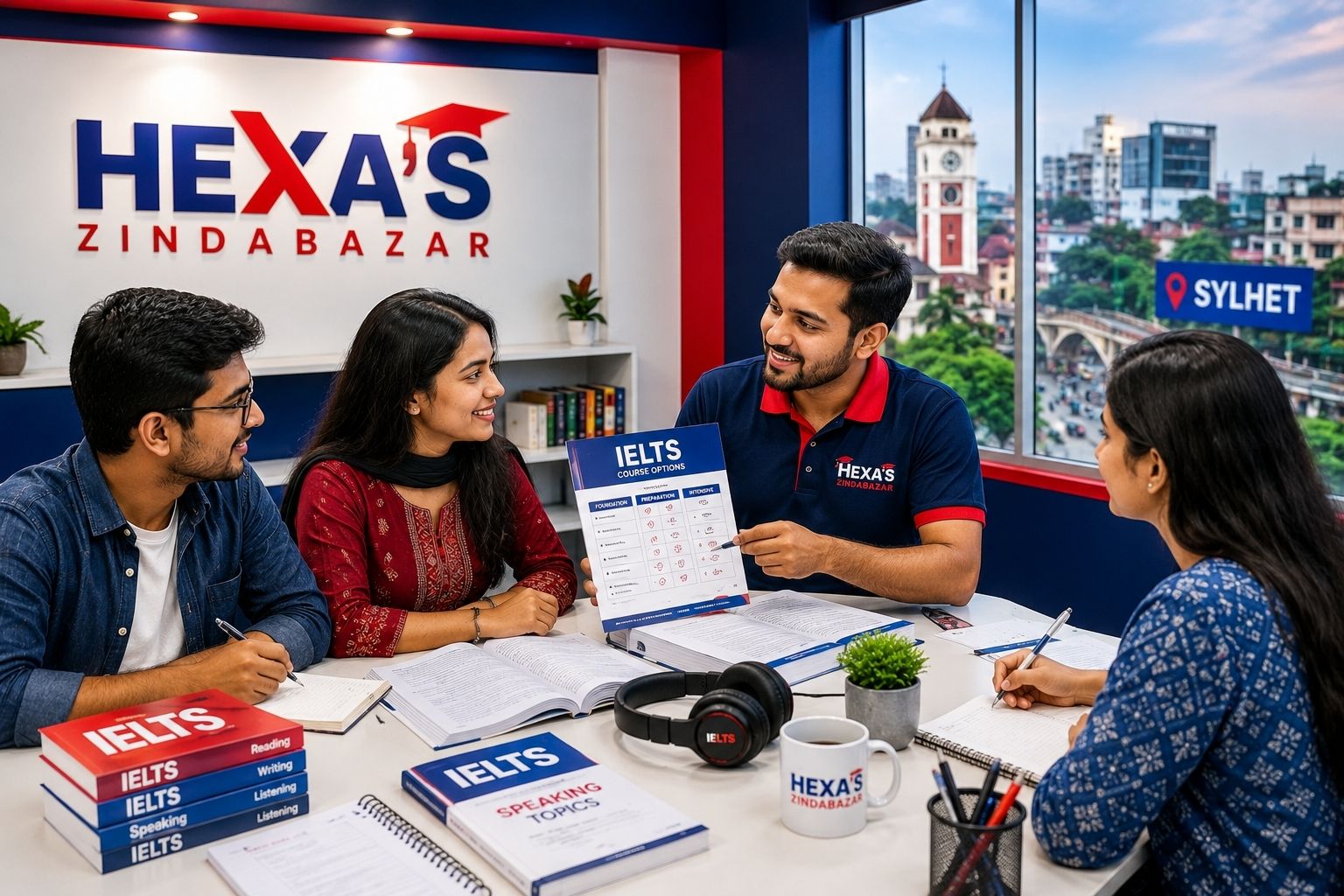
Speaking Practice at Hexa’s Zindabazar
For beginners, one of the biggest challenges is getting regular opportunities to speak and receive feedback.
At Hexa’s Zindabazar, IELTS candidates can combine structured preparation with practice, feedback, mock tests, and independent learning facilities.
Students can also use the Self-Access Centre for additional independent practice and the free Homework Station outside regular class sessions.
Hexa’s Zindabazar reports being recognised as a British Council Country Top Performer five times and receiving recognition in the UK for the highest growth in South Asia.
IELTS’s official website also lists British Council, Hexas Education Zindabazar as an IELTS test centre in Sylhet, offering Academic, General Training and UKVI IELTS tests.
For beginners, the advantage of a structured IELTS environment is not simply learning more Speaking topics.
It is developing a cycle of:
Learn → Speak → Receive Feedback → Correct Mistakes → Speak Again
Start With Topics You Already Know
You do not need hundreds of IELTS Speaking topics to start improving.
Begin with the subjects you already understand.
Talk about your family.
Describe your hometown.
Explain what you study.
Discuss your hobbies.
Talk about yesterday.
Describe your plans for tomorrow.
Once speaking about familiar subjects becomes comfortable, gradually move toward unfamiliar and abstract topics.
The objective is not to memorize the perfect answer to every possible IELTS question.
That is impossible.
The real objective is to develop enough fluency, vocabulary, grammatical control, and confidence to respond naturally when the examiner asks you something you have never practiced before.
That is when you are truly preparing for IELTS Speaking.
Ready to Improve Your IELTS Speaking?
Practising familiar topics is a strong starting point, but regular speaking, feedback, and correction can help you identify weaknesses more effectively. Explore IELTS Speaking Care, review our IELTS courses, or use our IELTS study materials to continue your preparation.
If you need help choosing the right preparation option, contact Hexa’s Zindabazar.
For IELTS preparation tips and updates, follow Hexa’s Zindabazar on Facebook and watch learning content on our YouTube channel.
Frequently Asked Questions
What are the best IELTS Speaking topics for beginners?
Beginners can start with familiar topics such as hometown, family, studies, work, hobbies, food, friends, travel, technology, daily routines, weather, and entertainment.
How should a beginner practise IELTS Speaking?
Choose one familiar topic, answer several questions aloud, record yourself, review hesitation and repeated mistakes, and answer the questions again. Gradually introduce more difficult topics as your confidence improves.
What topics are common in IELTS Speaking Part 1?
Part 1 commonly focuses on familiar subjects related to the candidate’s life, such as home, family, work, studies, and interests.
Should I memorize IELTS Speaking answers?
No. Use sample answers to understand how responses can be developed rather than memorizing complete scripts. Your goal should be to respond naturally to the examiner’s questions.
How long is the IELTS Speaking test?
The IELTS Speaking test lasts approximately 11–14 minutes and consists of three parts.
How can I make my IELTS Speaking answers longer?
A simple beginner strategy is Answer → Reason → Example. Give a direct answer first, explain why, and then add a short example or relevant detail.
Where can I practise IELTS Speaking in Sylhet?
Candidates looking for structured IELTS Speaking practice in Sylhet can explore IELTS Speaking Care at Hexa’s Zindabazar for information about the available support.