

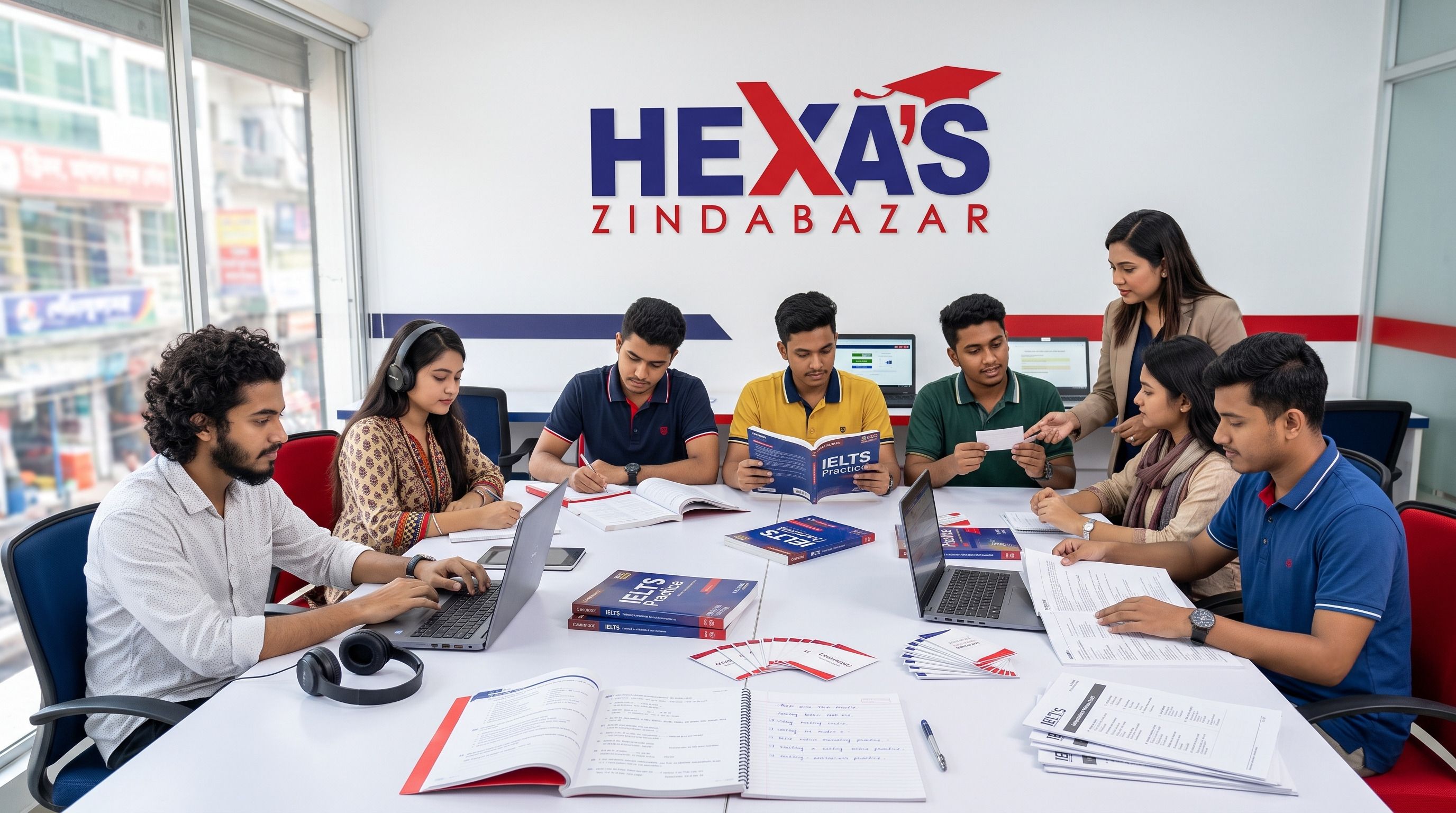
Preparing for IELTS can feel overwhelming, especially for first-time test takers. A quick search online reveals thousands of videos, websites, books, mobile apps, and practice materials claiming to help students achieve their target band score.
While access to many resources can be helpful, it often creates a new problem: students do not know where to start.
Some spend months watching random videos without following a structured plan. Others download countless PDFs but never complete them. Many candidates move from one resource to another, hoping to find a shortcut to a high score.
Successful IELTS preparation is not about using the largest number of resources. It is about choosing reliable materials and using them consistently.
For Bangladeshi students, selecting the right resources is especially important because preparation often takes place alongside school, college, university, or work. Students who need structured support can explore the available IELTS and English courses at Hexa’s Zindabazar.
This guide explains which IELTS preparation resources are useful and how to use them effectively.
What Makes a Good IELTS Preparation Resource?
Before selecting a book, website, app, or course, it is important to understand what separates a useful resource from an ineffective one.
A good IELTS resource should:
- Reflect the current IELTS test format
- Use realistic question types
- Provide clear explanations
- Build practical language skills
- Support timed practice
- Improve exam strategy
- Help students identify mistakes
Resources that promise Band 8 or Band 9 within a few days should be approached carefully. IELTS improvement usually requires consistent study, realistic practice, and regular feedback.
Students who are unsure where to begin can review the IELTS study materials provided by Hexa’s Zindabazar and compare them with their current level and target score.
Official IELTS Practice Materials
Official IELTS materials should form the foundation of any preparation plan.
Many students rely heavily on unofficial websites or social-media advice. Some of these materials may be useful, but they do not always reflect the real test accurately.
Official resources help students understand:
- Test structure
- Question format
- Timing
- Assessment criteria
- Task requirements
- Expected difficulty
The official IELTS website is a reliable starting point for test information and preparation guidance. Students can also use the official resources provided by the British Council and IDP IELTS.
These materials are particularly useful for checking facts about the exam and becoming familiar with authentic task types.
Cambridge IELTS Books
Cambridge IELTS books are among the most widely used preparation resources because they contain authentic-style practice tests.
They can help students:
- Practise under realistic conditions
- Understand recurring question patterns
- Improve time management
- Measure progress
- Identify weak areas
However, simply completing test after test is not enough.
After each practice session, students should review:
- Why an answer was wrong
- Which question type caused difficulty
- Whether time was managed effectively
- Which vocabulary or grammar problems appeared
- What should be improved before the next test
The biggest improvement usually comes from careful review rather than from the number of tests completed.
IELTS Preparation Websites
Online learning has made IELTS preparation more accessible to Bangladeshi students.
A useful IELTS website may provide:
- Practice exercises
- Model answers
- Vocabulary lessons
- Grammar explanations
- Writing guidance
- Speaking topics
- Test strategies
Students should prioritize websites that explain answers clearly and align their advice with official IELTS requirements.
Hexa’s Zindabazar also provides learning support through its Reading Care, Writing Care, and Speaking Care pages. These skill-focused resources can help students identify the areas that need the most attention.
YouTube Channels for IELTS Preparation
YouTube is useful for visual and demonstration-based learning.
Students can use IELTS videos to:
- Observe model Speaking responses
- Learn Writing structures
- Review grammar
- Understand Reading strategies
- Practise Listening
- Learn exam techniques
However, watching videos is passive learning. Real improvement happens when students apply what they learn.
After watching a lesson, students should complete a related task. For example:
- Write an introduction after watching a Writing lesson
- Record a two-minute Speaking response
- Complete a Reading passage under timed conditions
- Practise note-taking during a Listening activity
For lessons, student activities, and educational videos from the institute, students can visit the Hexa’s Zindabazar YouTube channel or browse the website’s video gallery.
IELTS Vocabulary Resources
Vocabulary is important in IELTS Writing, Speaking, Reading, and Listening.
Many candidates believe they must memorize thousands of difficult words. In reality, examiners value accurate, natural, and relevant vocabulary more than unnecessarily complex language.
A useful vocabulary resource should focus on:
- Topic-based vocabulary
- Academic words
- Collocations
- Synonyms
- Word forms
- Contextual usage
- Common spelling patterns
Students should avoid learning isolated words without examples.
A better method is to record:
- The new word
- Its meaning
- A natural example sentence
- Common collocations
- A synonym or related form
Vocabulary should then be used in Writing and Speaking practice.
Grammar Resources for IELTS
Grammar remains an important part of IELTS preparation.
Strong grammar helps students:
- Write clear sentences
- Avoid common mistakes
- Improve accuracy
- Express complex ideas
- Speak more confidently
Students do not need to master every advanced grammar rule. They should focus first on the structures that appear most often in IELTS.
These include:
- Verb tenses
- Subject-verb agreement
- Articles
- Complex sentences
- Relative clauses
- Conditionals
- Passive voice
- Punctuation
- Sentence boundaries
Grammar study is most effective when connected to actual IELTS tasks. For example, students can practise past tense while describing historical data in Writing Task 1 or use conditionals while answering hypothetical Speaking questions.
IELTS Listening Resources
Listening is one of the most trainable IELTS skills.
Useful resources include:
- Official IELTS recordings
- Podcasts
- Interviews
- News programmes
- Educational videos
- Academic discussions
Students should not focus only on understanding the general meaning. They also need to develop the ability to:
- Identify keywords
- Recognize paraphrasing
- Predict likely answers
- Follow conversations
- Notice changes of direction
- Understand different accents
Regular listening practice is more effective than occasional long sessions.
A student may begin with 15–20 minutes daily and gradually increase the difficulty.
IELTS Reading Resources
Reading success depends on more than vocabulary knowledge.
Many candidates struggle because they read every line slowly and try to understand every word.
Effective Reading resources should help students develop:
- Skimming
- Scanning
- Keyword recognition
- Synonym awareness
- Time management
- Question-type strategies
Students can improve by reading:
- News articles
- Academic articles
- Magazines
- Educational websites
- Reports
- Short research summaries
After reading, they should summarize the main idea and identify key details.
Students who need guided practice can explore Reading Care at Hexa’s Zindabazar, where the focus is on developing practical reading skills for IELTS preparation.
IELTS Writing Resources
Writing is often one of the most difficult IELTS modules because improvement requires more than practice alone.
Students need feedback.
A good IELTS Writing resource should provide:
- Model answers
- Structure guidance
- Task analysis
- Grammar correction
- Vocabulary advice
- Clear explanations
- Assessment-based feedback
Many candidates repeat the same errors because they do not know exactly what is wrong.
Useful feedback should identify:
- Whether the question was answered fully
- Whether ideas were organized logically
- Whether the overview was clear
- Whether examples were relevant
- Whether grammar errors affected meaning
- Whether vocabulary was accurate
- Whether paragraphs were developed properly
Students looking for detailed support can visit Writing Care at Hexa’s Zindabazar.
IELTS Speaking Resources
Speaking preparation should involve active communication.
Watching model answers can help, but students also need to speak regularly.
Effective Speaking resources should encourage candidates to:
- Record answers
- Practise cue cards
- Respond to follow-up questions
- Improve fluency
- Work on pronunciation
- Develop natural vocabulary
- Reduce hesitation
Mock interviews are particularly valuable because they simulate test pressure.
Students can use Speaking Care at Hexa’s Zindabazar to understand the type of guided support available for Speaking development.
Mobile Apps for IELTS Preparation
Mobile apps can be useful for short study sessions.
They may help with:
- Vocabulary revision
- Grammar exercises
- Listening practice
- Daily quizzes
- Progress tracking
- Flashcards
Apps are particularly useful during travel, breaks, or short free periods.
However, they should support a complete study plan rather than replace full Reading, Writing, Listening, and Speaking practice.
A mobile app may help students revise vocabulary, but it cannot fully replace teacher feedback on Writing or realistic Speaking practice.
The Importance of Mock Tests
Mock tests are among the most valuable IELTS preparation resources.
A good mock test can help students:
- Estimate their current level
- Identify weaknesses
- Improve timing
- Build confidence
- Experience realistic test pressure
- Track progress
Students should not take mock tests every day without reviewing them. Each test should be followed by analysis.
After a mock test, ask:
- Which section was weakest?
- Which question types caused errors?
- Was time managed effectively?
- Were mistakes caused by vocabulary, grammar, or misunderstanding?
- What should be practised before the next test?
Students can also review Hexa’s Zindabazar student success stories and institutional success highlights to understand how structured preparation and regular practice may support progress.
Why Expert Guidance Matters
Self-study can work well for disciplined learners.
However, some students find it difficult to identify their own weaknesses, particularly in Writing and Speaking.
Professional guidance may help with:
- Personalized feedback
- Study planning
- Error analysis
- Strategy selection
- Progress monitoring
- Motivation
- Exam-focused practice
Students who want to understand the institute’s background can read the About Hexa’s Zindabazar page and review its partners.
A structured learning environment can save time by helping students focus on the areas that need the most improvement.
Creating an Effective IELTS Study Plan
Even the best resources will not help without a clear plan.
A balanced preparation routine may include the following.
Daily Activities
- Vocabulary practice
- Listening practice
- Reading practice
- Short grammar review
Weekly Activities
- One or two Writing tasks
- Speaking practice
- Timed Reading sections
- Timed Listening sections
Monthly Activities
- Full IELTS mock test
- Progress review
- Study-plan adjustment
- Weak-area analysis
Consistency is more important than studying for many hours only once or twice a week.
Students should choose a schedule they can maintain.
Choosing Resources for Your Current Level
Not every resource is suitable for every learner.
Beginners
Beginners may benefit from:
- Basic grammar
- Foundation vocabulary
- Guided Reading practice
- Simple Listening activities
- Structured Speaking support
Intermediate Students
Intermediate learners should focus on:
- Question-type strategies
- Time management
- Writing structure
- Speaking fluency
- Mock tests
Advanced Candidates
Advanced students should concentrate on:
- Accuracy
- Detailed feedback
- Weak-area correction
- Higher-level vocabulary
- Score refinement
- Realistic test practice
Students who are unsure which course or resource matches their level can review the available courses or contact Hexa’s Zindabazar for guidance.
Building a Balanced IELTS Preparation Strategy
Strong IELTS candidates rarely depend on one resource.
A balanced plan may combine:
- Official IELTS materials
- Cambridge practice books
- Online lessons
- Vocabulary study
- Grammar review
- Listening practice
- Reading practice
- Speaking activities
- Writing feedback
- Mock tests
The most effective IELTS preparation resource is not always the most expensive or popular. It is the one that helps the student practise consistently, understand mistakes, and improve over time.
Students can also review the Hexa’s Zindabazar photo gallery and video gallery to see more of the learning environment and activities.
IELTS Exam Registration Support
Preparation and test registration are separate stages.
Before booking the test, students should confirm:
- Test type
- Test date
- Test location
- Required identification
- Registration fee
- Cancellation policy
- Rescheduling rules
Students who need support can visit the IELTS exam registration page and also check the frequently asked questions for common guidance.
Final
The best IELTS preparation resources for Bangladeshi students are those that reflect the real exam, match the student’s level, and support regular practice.
Official materials, Cambridge IELTS books, quality websites, structured courses, skill-specific guidance, mock tests, and expert feedback can all play an important role.
The key is not to collect more resources. The key is to use a smaller number of reliable resources with a clear plan.
Students who combine authentic materials, steady practice, regular feedback, and realistic mock testing place themselves in a stronger position to reach their target IELTS band score.
For IELTS tips, class updates, videos, and student activities, follow Hexa’s Zindabazar on Facebook, YouTube, TikTok, Instagram, LinkedIn, and X